The best chance you'll ever get to sell your Brantford home well is the first two or three weeks it's on the market. After that, quietly, the odds start working against you.
People say the early weeks matter — I've said it for years. But a while back I realized I'd never actually checked whether it was true, or why. So I pulled every sale in the City of Brantford from the last twelve months — 1,283 of them — and went looking.
It's true. And the reason matters more than the number, because it changes what you should actually be afraid of when you price your home.
First, the trick everybody falls for
Here's something you hear all the time.
A house lists at $700,000. Cuts to $620,000. Sells for $610,000. And everybody says: "98% of asking. Great result."
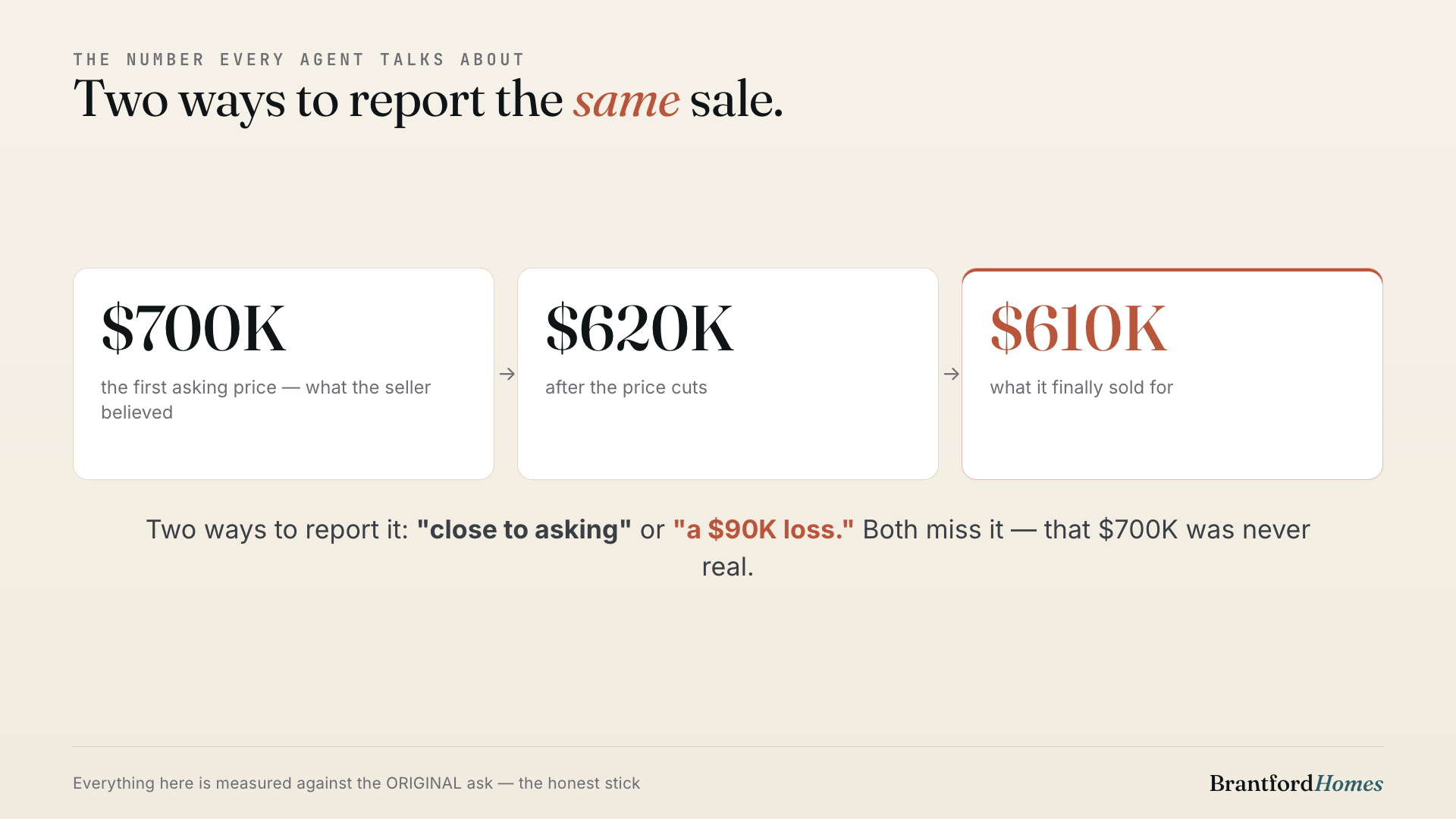
Sure. But 98% of which asking? Not the first one.
And here's the part I want you to sit with: that seller didn't lose $90,000 at the negotiating table. That $700,000 price was never real. Nobody was ever going to pay it. The cut just told the truth about a number that was made up on day one.
So the price reduction isn't the story. It's the market correcting a price that was never going to work. The real cost is somewhere else — and you can't see it on the listing.
(One housekeeping note, because it matters: the "sale-to-list" stat you usually see is measured against the final price, after the cuts. It makes slow sales look fine. So for everything below, I measured every sale against the original asking price — the first number, the one the seller actually believed on day one.)
The slide — and what it really is
Sold in first 3 weeks
~99%
Of original asking price kept
Sold after 90+ days
~91%
Of original asking price kept
Sold over asking — fast
1 in 3
Homes that sold within 3 weeks
Sold over asking — slow
1 in 14
Homes that took longer
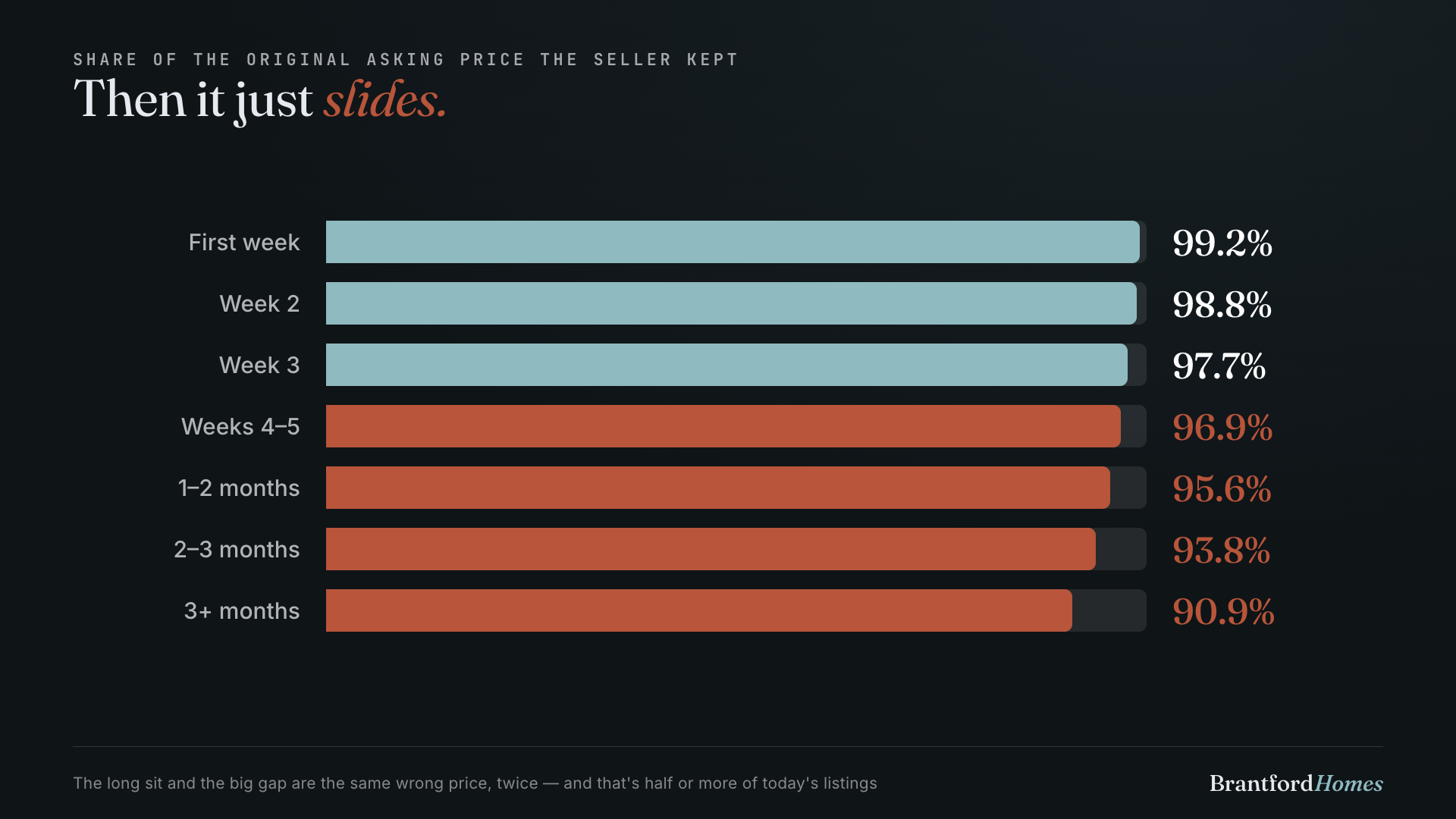
Laid out by how long each home took to sell, it's a slide that only goes one direction:
| Time to sell | Sales | Typical % of original ask | On a $600K ask |
|---|---|---|---|
| First week | 110 | 99.2% | ~$595,000 |
| Week 2 | 260 | 98.8% | ~$593,000 |
| Week 3 | 185 | 97.7% | ~$586,000 |
| Weeks 4–5 | 170 | 96.9% | ~$581,000 |
| 1–2 months | 333 | 95.6% | ~$574,000 |
| 2–3 months | 123 | 93.8% | ~$563,000 |
| 3 months + | 102 | 90.9% | ~$545,000 |
There isn't a rung on this ladder where waiting longer got sellers more money. Not one.
But read the slide carefully, because it's easy to draw the wrong lesson from it. This is not the market punishing patience. The homes way down at the bottom didn't sell low because they sat. They sat because the first price was wrong — and the long sit and the big gap are the same problem showing up twice. Priced right, homes sell fast, near their number. Priced wrong, they sit, then they slide. Same cause.
So the money the overpriced seller lost was never the size of the price cut. It was every week that house sat at a number nobody believed — while the buyers who would have paid a fair price were booking showings somewhere else.
To see why those first weeks are worth so much, you have to know who's watching.
Who's actually watching
Your biggest audience isn't the people casually browsing on a Saturday. It's the buyers who've been waiting — sometimes for months — for a house exactly like yours. They've got the search alert. They're watching every morning. And the day you go live, they all see it at once.
That's the spike. Day one is the biggest crowd your listing will ever have. After the first couple of weeks, those people have seen your house and made their call, and you're down to whoever's brand-new to the market that week — a trickle, not a crowd.
Which means your house gets exactly one launch. One first impression, in front of the people most likely to pay the most, because they're the ones who've been waiting. Price it right and that crowd competes — that's where over-asking offers come from. Price it high "to leave room," and that same crowd sees the wrong number, quietly crosses you off, and moves on. You don't get a second launch.
What overpricing actually does
The numbers show exactly how this plays out.
- Homes that sold inside three weeks almost never cut. Of 555 fast sales, just 13 reduced before selling — about one in forty. They finished within a few thousand dollars of their ask — normal back-and-forth, nothing more.
- Homes that took longer cut constantly. Four in ten reduced at least once, and finished about $30,000 below where they started.
And the cleanest tell of all is the over-asking sales. Among the fast sales, about one in three sold at or above asking. Among the slow ones — one in fourteen.
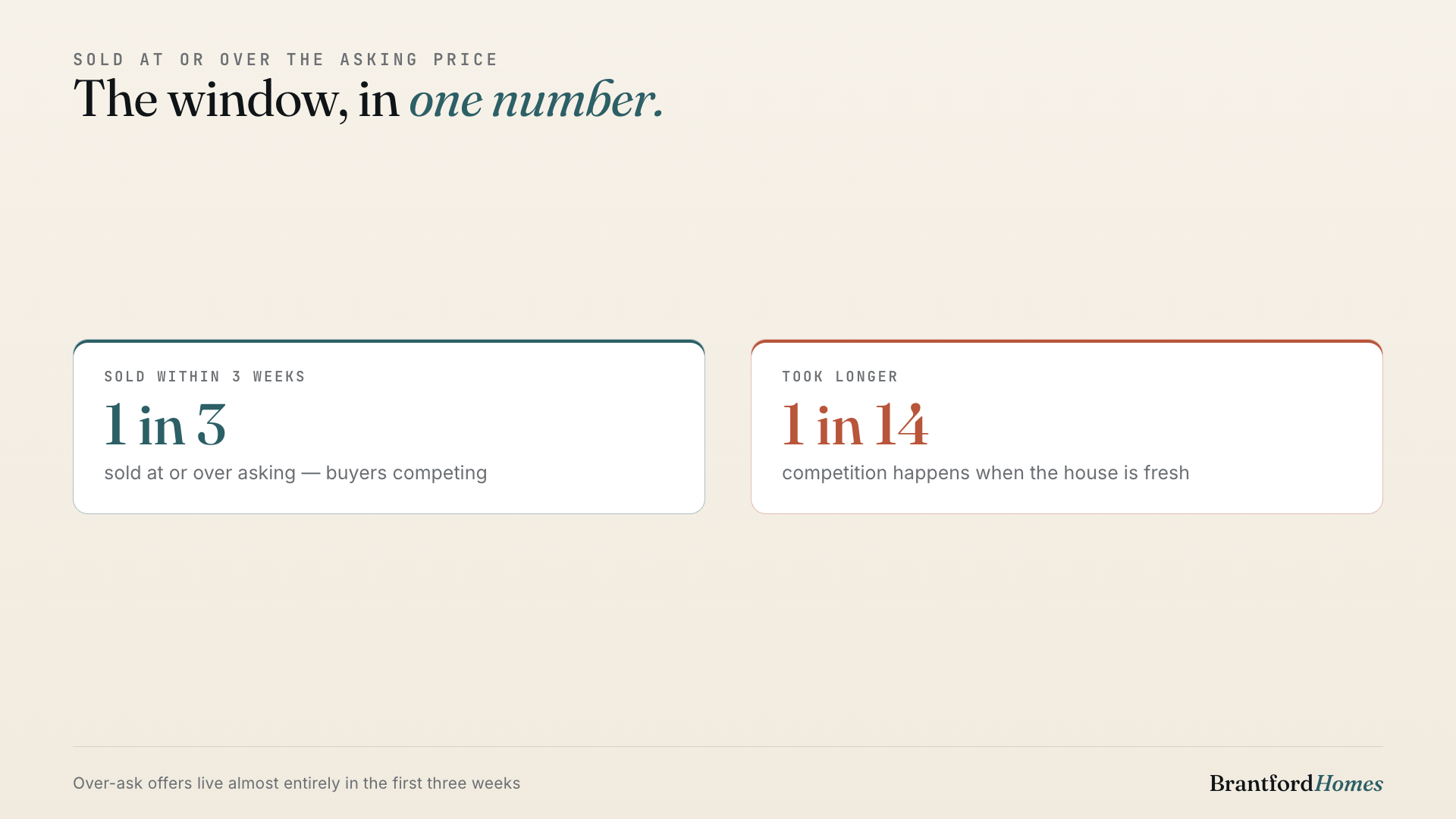
One in three versus one in fourteen. That's the window in a single number. Competition happens when the house is fresh and priced where buyers already believe it should be. Once the days-on-market counter starts climbing, that number sits in the listing doing the buyer's negotiating for them. Buyers aren't being difficult — they're just being careful not to overpay for the house they think nobody else wanted. The counter tells them a story, and an overpriced launch handed it to them.
Okay — but is it always the price?
Honestly, no. Some homes take longer for good reasons: genuinely unusual properties, tenanted homes that are hard to show, estates, homes that need work when buyers want turnkey. A slow sale doesn't automatically mean the seller got it wrong.
But here's the tell. Those four-in-ten slow sales that cut and then sold? Most landed close to where an honest day-one price would have started. Same destination — they just paid for it, in months of carrying costs, in stress, and in the leverage they gave away.
I've had sellers call me six weeks in wishing they'd listened to the market sooner. Nobody's ever called to say they wish they'd argued with it longer.
And the sellers who never adjusted at all? I followed all 602 of this year's failed listings to see what happened next. Short version: half came back — an average of $53,000 lower.
If it was my house
Sellers don't usually overprice by a hundred grand. They overprice by twenty-five — "to leave room to negotiate." It feels safe. And early in my career, I helped sellers build in that cushion too, so I get it.
But I've watched it enough times now to say it plainly: that cushion is the thing that costs you the window. It doesn't protect your price. It quietly spends your best two weeks — the buyers who would have paid your real number are booking showings at the house down the street that's priced at it.
So if I was selling my own house tomorrow — my money, my move:
- I'd price it to the last 90 days. What homes like mine actually sold for, recently. Not what my neighbour got in 2022 — that's nostalgia with a sign on the lawn.
- I wouldn't launch until it was ready. The window only works if the house looks its best from hour one. A great price with bad photos wastes the crowd just the same. Getting a house ready properly takes about six weeks — here's the order I'd do it in.
- I'd decide my week-three checkpoint before day one. Strong showings by day 14? A real offer by day 21? If not, the market has answered — and I'd move while the listing is still fresh enough to matter, not six weeks later when the crowd is gone.
All of this turns on one thing: knowing your real day-one number. That's exactly why I built BrantfordHomes.com — so homeowners can see what I see every day: what's selling, what's sitting, and who your competition is this weekend.
See what homes actually sold for.
Register free for Insider access — sold prices the portals don't show, new listings before everyone else, and my honest monthly read on the Brantford market. No spam, unsubscribe anytime.
Frequently asked
Should I price my house high to leave room for negotiation? The Brantford data says no. Pricing high doesn't protect your number — it spends your most valuable asset, the first two-to-three weeks when your most motivated buyers are watching. Homes priced at the market sold within weeks near full ask and won almost all the over-asking offers; homes priced above it took months and finished about $30,000 below their original number. The price cut you're picturing was never the real cost. The wasted window is.
What percentage of asking price do Brantford homes sell for? Against their original asking price, the typical Brantford home over the past year sold for about 96–98% — but the spread is the story. Homes selling within three weeks kept about 99% of the first ask; homes taking 90+ days kept about 91%. The "sale-to-list" figure you usually see is measured against the final price after cuts, which flatters slow sales.
What happens if my house doesn't sell in the first month? The market is telling you something — usually the price, with presentation the rest. Sellers who make a real correction around week three typically still sell in a normal overall window. Sellers who wait it out slide down the ladder, and some end up in the failed-listings pile.
Do homes that sell fast sell for less? The opposite, in this data. Fast sales kept the largest share of their asking price and made up nearly all the over-ask sales — about one in three homes that sold within three weeks got full original ask or better, versus about one in fourteen of the slower ones. Speed isn't the goal; it's the symptom of a right price meeting its full audience.
How do I know what my home's real day-one price is? Sold comparables — same home type, same area, last 90 days — plus an honest read of your home's condition against those comps. Online estimates can't see your kitchen or your street. Start with a real valuation — and whatever number anyone gives you, if it's more than a few percent above the recent comps, make them show you the sales that back it up.